
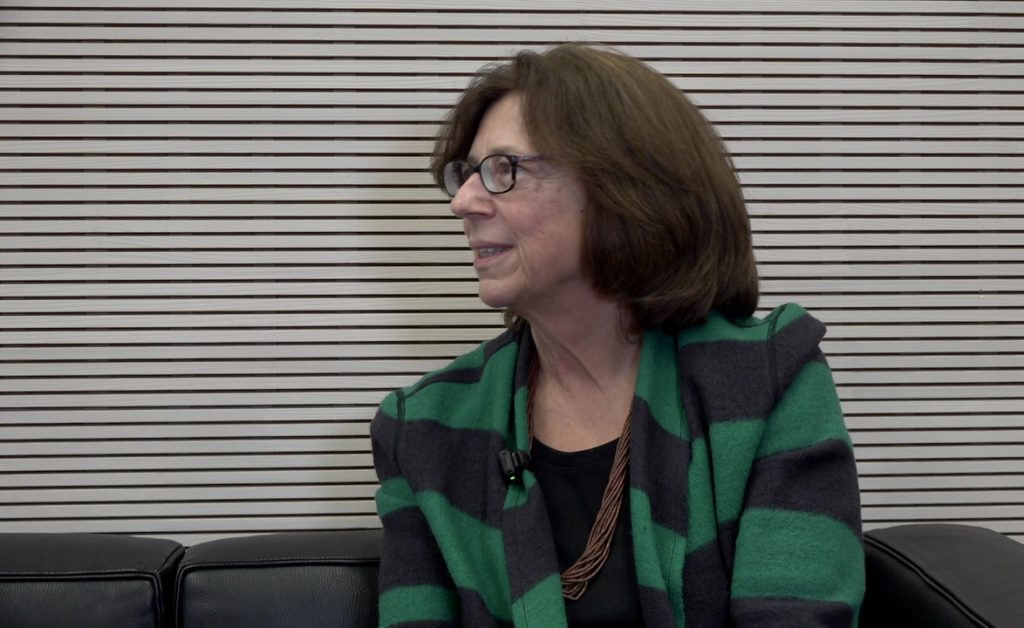
Ursula Keller was born in Zurich in 1959 and grew up in a traditional working-class family at a time when women in Switzerland still did not have the right to vote. These early social conditions shaped her awareness of gender equality, as did her family environment. While her mother embodied the traditional role of the housewife, Ursula Keller developed a desire from an early age to pursue a different path. Her childhood was marked by curiosity, independence, and a strong interest in scientific phenomena. Despite initial difficulties at school, partly due to dyslexia, her mathematical talent was recognized and encouraged early on.
After transferring to the cantonal school, she decided to study physics at ETH Zurich – a path that was still unusual for women at the time. There, she soon became one of the few women in her field. After completing her degree, she moved to the United States, where she earned her doctorate at Stanford University. Her time in the U.S. proved formative: she experienced an academic environment that strengthened her confidence in her own abilities and opened up new perspectives. She then worked at Bell Labs, one of the world’s leading research centers in photonics, where she further developed her scientific career.
In 1992, Ursula Keller was appointed as the first female professor of physics at ETH Zurich. Her return to Switzerland marked not only a personal milestone, but also an important step for the visibility of women in science. Despite her outstanding achievements in research and teaching, she faced structural resistance and gender-specific inequalities in academic life. These experiences led her to become increasingly involved in advocating for institutional change and the promotion of women in science.
As an internationally recognized scientist in the field of laser technology, Ursula Keller has received numerous awards and supervised more than one hundred doctoral students. In addition to her scientific excellence, she is distinguished by her commitment to equality, transparency, and good governance in academic institutions. Her life story vividly demonstrates how individual determination and critical reflection on institutional structures can work together to bring about lasting change.