
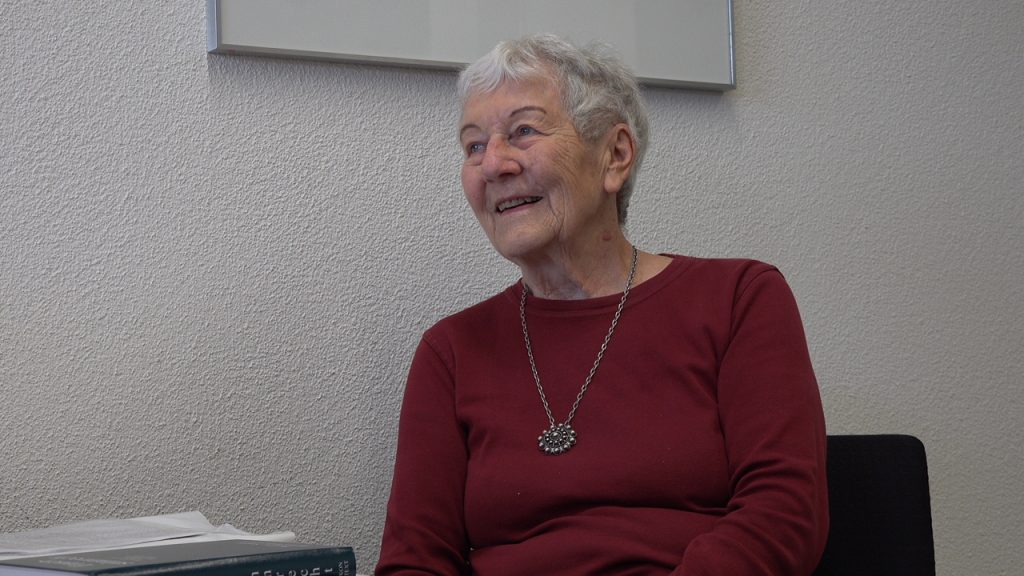
Ursula Mauch was born in 1935 in the canton of Aargau and grew up in a family that ran a butcher’s shop. She was originally expected to work as a saleswoman in the family business, but an inspiring chemistry teacher awakened in her an early enthusiasm for the natural sciences. After a year at the Neuchâtel commercial school and an internship in a laboratory, she completed a degree in chemistry at the Technikum Winterthur – today’s ZHAW – as one of only two women in her cohort.
In 1959 she emigrated to the United States with her husband, where she lived for several years and raised three children. After returning to Switzerland, she worked as a chemistry and physics teacher at the Aarau vocational school. In 1976 she founded, together with her husband, the consultancy firm Infras, which specialized in environmental and energy policy. The idea for this work emerged after a stay at MIT in the early 1970s, when she engaged intensely with the debates surrounding the limits to growth.
Politically, Ursula Mauch first became active in the reform-oriented Team 67 and was elected to the Grand Council of the canton of Aargau in 1974. Starting in 1977 she was a member of the Social Democratic Party, and in 1979 she became the first woman from Aargau to be elected to the National Council, where she served for 16 years. In 1987 she also became the first woman to chair a parliamentary group within the Federal Council. In this role, she saw herself as a pragmatic yet determined bridge-builder between generations and genders. Looking back on this period, she said:
“The most important thing our parliamentary group and our party achieved was the election of Ruth Dreifuss to the Federal Council. We succeeded in preventing the election of yet another man. We managed this so perfectly that I am convinced: there will never again be a Federal Council without women.”
Her political work was shaped by environmental and energy policy issues, including opposition to nuclear power plants and participation in drafting the Environmental Protection Act. Ursula Mauch stands as an example of a generation of women who broke new ground in the natural sciences, politics, and environmental issues, and in doing so helped lay the foundations for a more sustainable and equal Switzerland.