
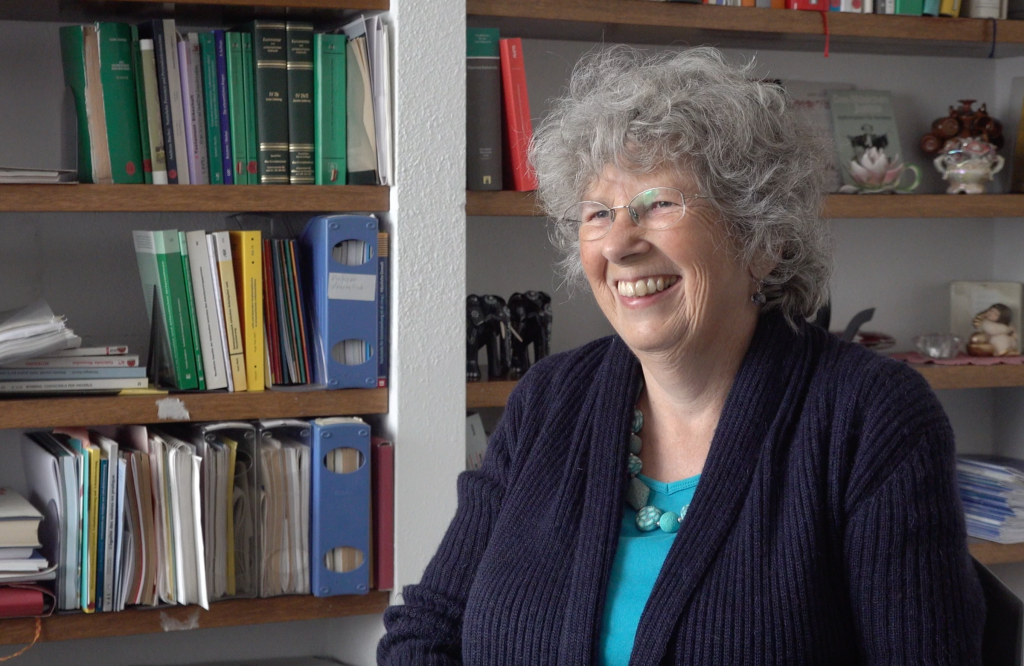
Rosemarie Weibel was born in 1962 in the Canton of Bern. Her father, a trained shoemaker, worked as a warehouseman, and her mother, a trained preschool teacher, took care of the household and the children, as well as the large vegetable garden, gave flute lessons at home, and occasionally took on substitute teaching. When Rosemarie Weibel was thirteen years old, her father became disabled. From then on, the responsibility for the family (with three children, the youngest just two years old) fell on the mother, who returned fully to the profession. These circumstances taught Rosemarie Weibel early on to take responsibility and to understand independence as a fundamental value.
Her path to legal studies was anything but straightforward at first. After finishing school, she attended a commercial college, worked in various professions, and came into contact with the legal field rather by chance when she took a job as a secretary in a law firm. There, she met a liberal-minded lawyer and his wife, the first female lawyer in Ticino. Against societal doubts and with great personal commitment, she studied law at the University of Zurich and subsequently obtained her bar qualification.
Professionally, Rosemarie Weibel specialized in family, labor, and social insurance law, as well as their intersections with migration law, always with particular attention to social justice and to people in difficult economic circumstances. She was active in the Federazione delle Associazioni Femminili Ticino and worked with trade unions, supported legal continuing education – especially on the Gender Equality Act – and edited the platform sentenzeparita.ch, which documents court rulings related to the Gender Equality Act. For her, law never stood in isolation but was always connected to concrete lived realities: she understood legal work as a combination of rationality, empathy, and social responsibility.
She is involved in feminist and legal-political networks such as the Coordinamento donne della sinistra and the Swiss Institute for Feminist Legal Studies and Gender Law (FRI). Particularly important to her is the horizontal, collegial organization of such groups – without hierarchies, with shared responsibility and rotating leadership. For her, these forms of collaboration embody a “different kind of politics”, grounded in relationships and mutual support.
In her legal work, she dealt with issues such as equal pay, domestic violence, discrimination in labor law, and the legal uncertainties faced by migrant women after separation or divorce. Throughout, she upheld the conviction that gender equality and social justice are inseparable. She encourages young women not to lose hope or perseverance, to build networks, and to practice solidarity – mindful of the fact that progress in gender equality is never guaranteed and that political change arises from relationships, not only from programs.